Advanced Leadership Program
Turning an ambirious leadership strategy into a scalable data informed development experience for a complex organisation
The challenge:
A large global science and technology organisation was preparing its experienced mid-level leaders for a period of significant growth, transformation and increasing complexity.
These leaders sit at a critical point in the organisation: translating strategy into action, aligning teams and functions, making decisions under uncertainty and shaping culture on the ground. But rapid growth had created a fragmented leadership environment, with no single shared leadership language, set of behaviours or consistent development offer for this population.
The organisation needed a development experience that could strengthen decision-making, ownership, cross-functional collaboration, psychological safety, influence and strategy execution — while remaining practical enough to transfer into leaders’ day-to-day work. The programme also had to work globally, in both blended and fully virtual formats, and ultimately scale to up to 2,000 experienced leaders.
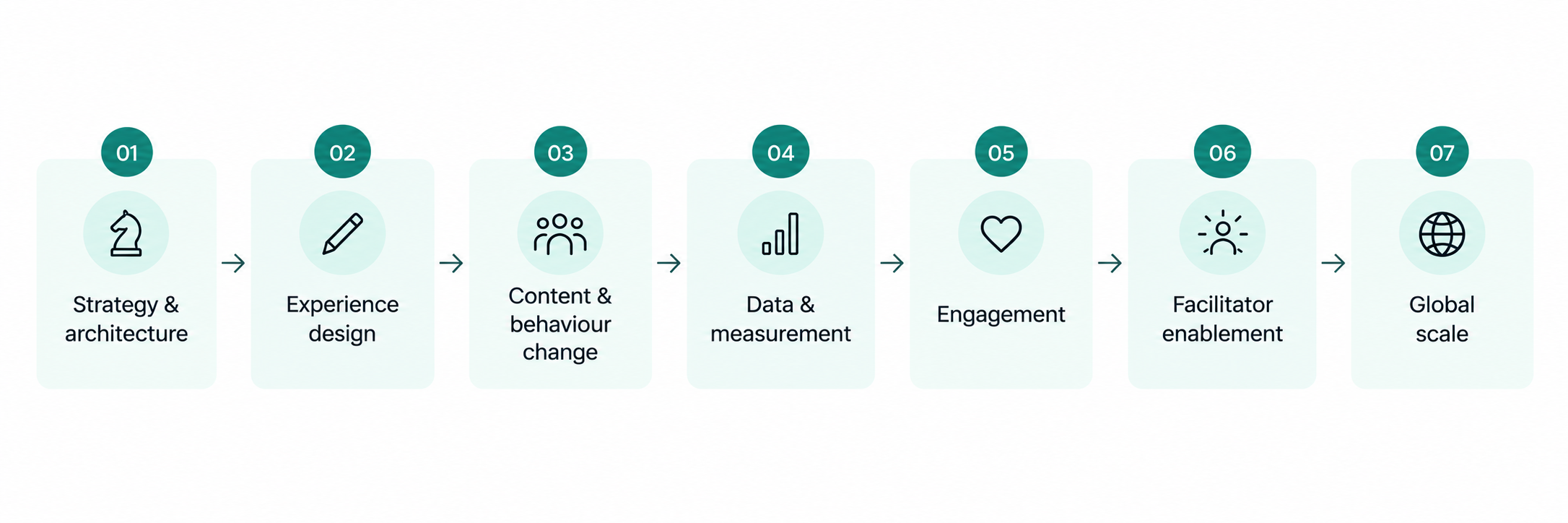
My role was to help turn that ambition into a scalable leadership system: designing the programme architecture, learning experience, behavioural and data strategy, engagement approach and facilitator model, and translating the organisation’s strategic priorities into leadership behaviours that could be practised and measured in real work.
The solution: designing the program end-to-end
I was responsible for the end-to-end design of the Advanced Leadership Program — translating the organisation’s leadership strategy into a scalable development experience that could work across functions, cultures and geographies.
My role started well before content design. I helped define what the programme needed to achieve, how it should sit within the wider leadership portfolio, which behaviours mattered most, and how those behaviours could be developed and measured over time. From there, I designed the overall programme architecture: a multi-stage journey combining live immersion, self-directed digital learning, workplace experiments, peer learning, facilitated Learning Circles and a final Impact Studio.
I created the core I–We–It development framework, moving leaders from leading self, to leading teams, to leading within the wider organisational system. I also built the programme’s recurring behavioural threads — decision-making and prioritisation, psychological safety, influence and cross-functional collaboration, and leading change — so that participants repeatedly practised the same critical capabilities in increasingly complex contexts.
Beyond the learning architecture, I designed the content, participant experience and measurement strategy: scenario-based assessments, pulse checks, behavioural experiments, reflection activities and data capture that could show not only whether people enjoyed the programme, but whether they were applying it differently at work. I also shaped the digital journey, engagement approach and the logic for using participant data to identify wider organisational barriers to leadership performance.
Finally, I designed the programme for scale. That included the facilitator model, detailed facilitator guides, session flows, behavioural observation criteria, train-the-facilitator support and clear design principles for what needed to remain consistent across cohorts and where facilitators could adapt. The result was not a collection of leadership workshops, but an integrated leadership development system designed to scale in both blended and virtual formats.
The result:
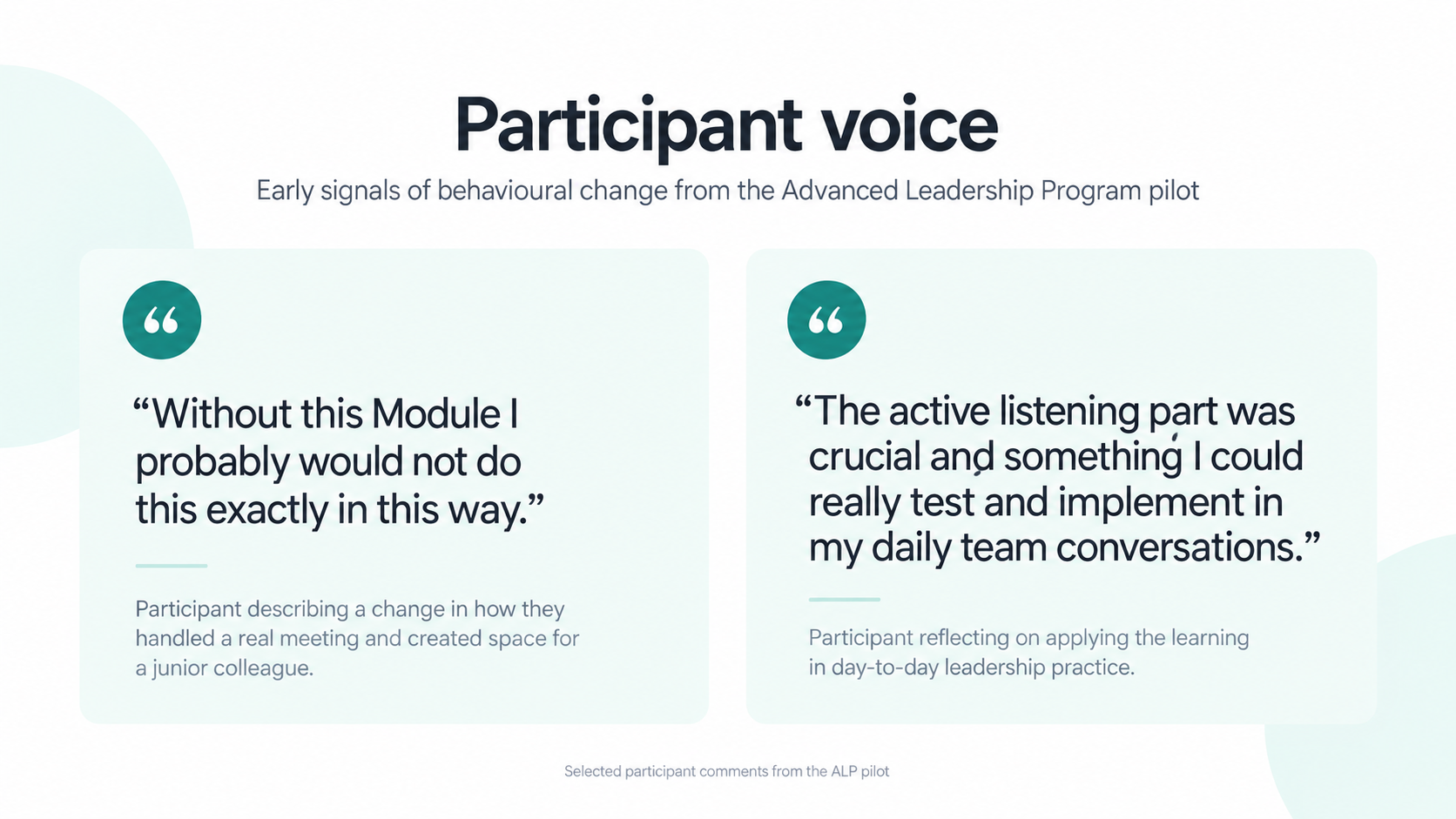
The programme is still in its pilot phase, so long-term organisational impact is still being measured. However, early results from the first cohort show strong signs that learning is transferring into day-to-day leadership behaviour.
100% applied the learning at work
Every respondent to the Module I pulse check had already used an idea, tool or practice from the programme in a real leadership situation.
82% had applied it more than once
More than four in five respondents reported repeated application, suggesting that the learning was beginning to move beyond a one-off training experience into everyday leadership practice.
94% reported pausing differently under pressure
Participants were beginning to interrupt automatic responses and make more deliberate leadership choices in difficult or ambiguous situations. Their examples included calmer difficult conversations, earlier communication, clearer expectations and giving others more ownership rather than stepping in to solve the problem themselves.
Leadership experiments were moving into the workplace
By the first Learning Circle, 67% of respondents had begun a formal workplace experiment. Almost half of experiment reflections focused on enabling others rather than taking over, reinforcing an emerging shift from control towards empowerment and shared ownership.
75% rated the coaching experiment very or extremely useful
In the team-leadership phase, 90% also described staying curious before giving advice as manageable or easy — an encouraging signal that coaching behaviours were becoming usable in real conversations.
Strong engagement over time
The digital experience also showed sustained engagement rather than simple first-time access. All 30 leaders in the pilot cohort accessed the platform; at the measurement point they had logged in an average of 15 times each and spent a median of more than 12 hours engaging with the programme.
Turning learning data into organisational intelligence
One of the most valuable early outcomes came from the data architecture itself.
Analysis across assessments, pulse checks, workplace experiments and Learning Circles began revealing recurring organisational barriers: competing priorities, unclear ownership and decision rights, difficulty challenging under pressure, leaders taking over rather than empowering others, and weak learning loops.
This meant the programme was doing more than developing individual leaders. It was also creating a feedback system that showed the organisation where leadership behaviour and organisational conditions were reinforcing — or getting in the way of — strategy execution.